Sunday, July 29, 2007

DHARMA BUM III in Pago Pago, American Samoa -- 29 July 2007

Pago Pago, American Samoa  --  29 July 2007
 
When we went through the pass at Taapuna in Tahiti, we got the wind on the nose immediately.  Also, it rained all the time and was quite cold.  Soon the wind turned into a "Maramu", which lasted for a couple of days.  The heavy-duty hinge on our freezer door broke in all this rattling chaos, but after two days Maiao Island lay astern.  When the wind got lighter I tightened my shrouds by three turns each, as I didn't like the way the leeward one was swinging about.  The wind continued to lessen, so that we only made 41 miles on the seventh day. 
 
The lack of wind didn't bother us one bit, we didn't use the engine, but concentrated on good food like wonderful Shuijiao, which reminded us of our life in Taiwan.  From LADY JANE III, we finally know that we definitely fall into the category of "foodies".  I guess there are worse categories to fall into. 
 
Rather unpleasant was the steadily growing list of things to repair or replace.  The preheat on our port engine didn't work anymore, so I took the whole shebang out, deposited it in strategic places in the cockpit and rewired it all.  After I put it back in, everything worked just fine again.  At least one of my batteries must have died on me, but I wasn't all that keen on dealing with battery acid while being thrown all over the place.  So I decided to leave things alone until we were in port.  There were leaks from the cooling water, the topping lift had almost chafed through at one of the sail batten flaps and two of the battens continued to work themselves loose.  One of my V-belts couldn't be tightened anymore and so we never were in danger of boredom. 
 
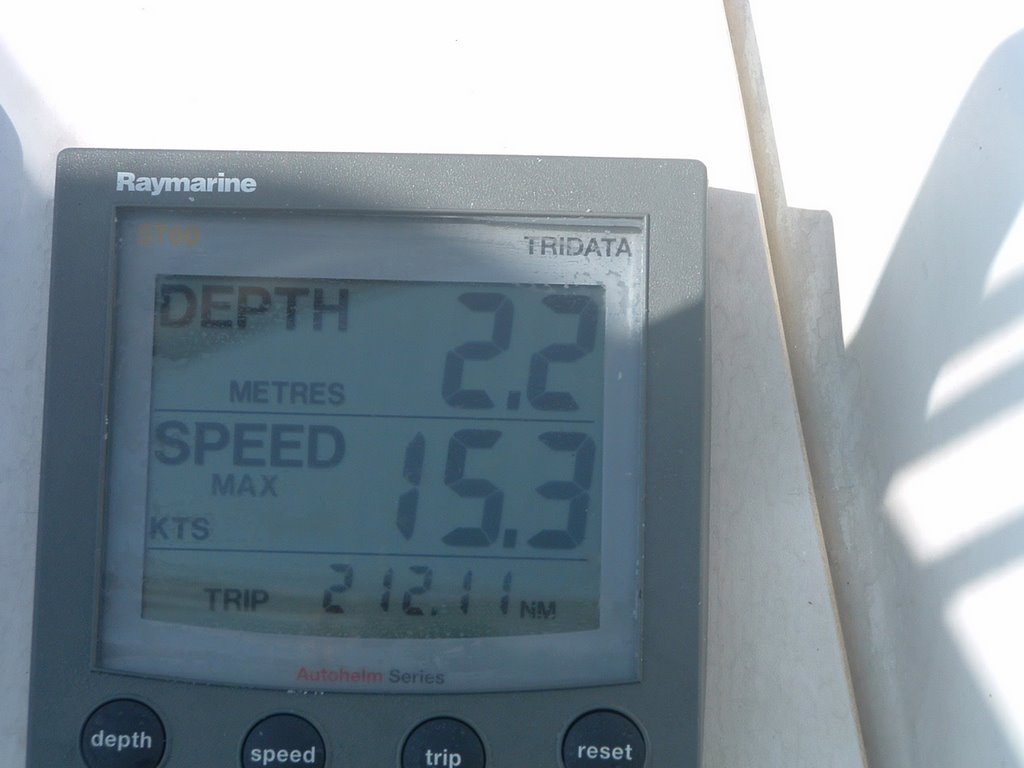
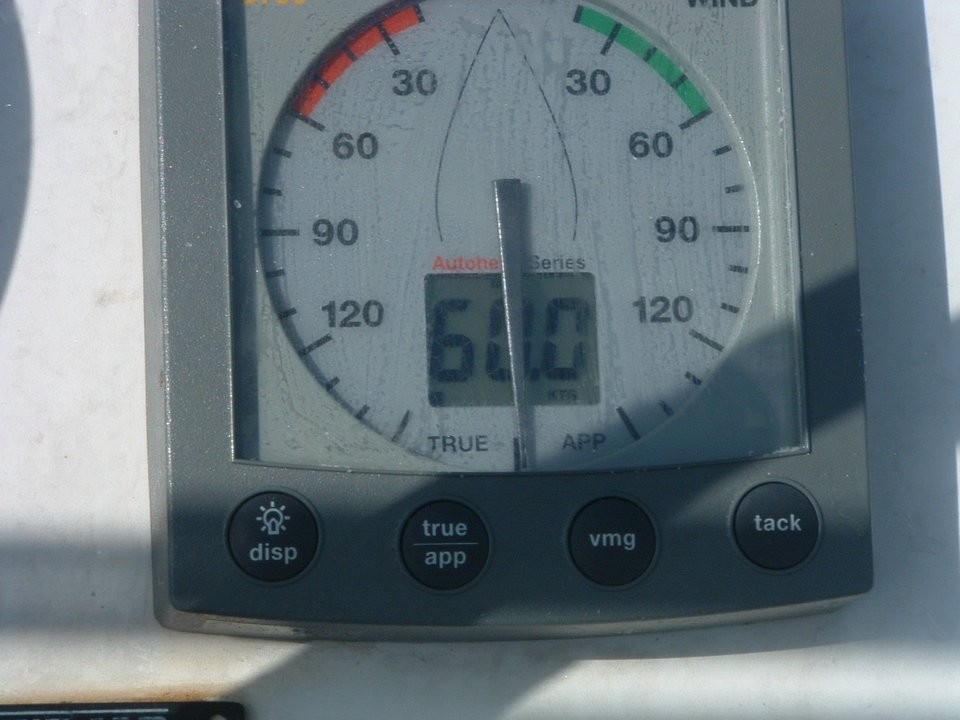
On the ninth day we experienced a gale, which had me sitting in winter clothes and raingear at the helm trying to make sure that we took the seas from behind.  Maximum windspeed was 46 knots while our maximum boat speed was 11,2 knots, which is actually rather slow for these conditions.  After about three days things returned to normal and we set our watches to UTC - 11 hours, the time in American Samoa.  It coincided exactly with our position as noon was at 12:00 o'clock. 
 
On 16 July a particularly heavy squall with lots of rain came upon us, when I noticed big greenish shapes in the water near us.  They were about twice as long as our boat, perhaps 24 meters and they could definitely move faster than us although we were moving at a good clip.  I shouted "Thar she blows!" when the first one surfaced and I immediately noticed a comparatively small sickle-shaped dorsal fin on the grayish black body.  This was one of the biggest whales I had ever seen.  When I later checked with the help of various books and an encyclopedia, I came to the conclusion that we were dealing with a pod of Fin Whales (Balaenoptera Physalus), the second biggest beings on our planet.  The biggest ones ever are the Blue Whales, which weren't even surpassed by the dinosaurs. 
 
Unfortunately we couldn't continue watching these amazing creatures as the weather worsened and I had to give full attention to my boat.  My favorite big rum and tonic glass jumped out of the kitchen shelf and shattered on the galley floor.  Two sail battens came loose and three mast sliders disintegrated, so when the weather got better I took down all sail and sewed on new ones with thick straps.  So much for not reefing when the weather gets worse. 
 
After I had inspected my new bruises, cuts et cetera I continued to sleep in a twenty-minute rhythm.  I was just too tired to stay awake continuously, but the cellphone didn't only serve very well as a mini torchlight, but as an egg-timer, stopwatch, calculator, computer game and so on as well.  If we ever come back to Trinidad, we'll spend another ten bucks and buy two more. 
 
On the eleventh day we finally got what Bernard Moitessier in "Sailing To The Reefs" called one of the essentials of a sailor's paradise.  A steady four Beaufort and blue skies.  Years ago, I considered Force four as barely enough for real sailing.  These days it suits me just fine.  Interestingly enough, I leave up a lot more sail than I used to.  On this trip I hadn't reefed even once, gale or no gale.  I simply cannot imagine capsizing this boat without the help of a massive sea.  First all kinds of things would break (see above) and then I would imagine the stick to go overboard.  Not that I want to experience that!  I guess the essential difference to the Prout Snowgoose 35 DHARMA BUM I  catamaran and the Ed Horstman Tri-Star 38 DHARMA BUM II trimaran is the seven meters of beam and the resulting ratio on our boat.  It makes it so much more stable and as the storm of Colombia showed, so much safer in really heavy weather as well. 
 
The next day we had a delicious cabbage-lasagna and Aurora Ulani asked us: "How could the GPS and the autopilot possibly communicate with each other?!?  After all they have neither a mouth nor ears!" 
 
The last few days were characterized by confused seas and unpleasant motion, but finally American Samoa came into sight and just before midnight we took down all sail to wait for daylight.  The next morning we motored into the harbor, avoiding three canoes and getting circled by the big Police-RIB.  We anchored in ten meters of fish soup and waited until Monday to clear in.  Otherwise we would have to pay hefty overtime fees. 
 
We soon realized that Pago Pago is a lot better than its reputation.  Sure, the fish factories dominate the harbor, pollute the water and the smell is sometimes quite strong.  But the Samoans are very friendly and where we expected a small city of some kind, we only found one very long village which stretches from one end of the island to the other.  Buses are inexpensive, so are the goods and the hospital.  We all went to the dentist to have our teeth checked and cleaned.  For the whole exercise we paid all in all only US$ 60 and got tooth brushes, a dentist's mirror, plenty of dental floss and dental floss threaders for free.  As the dentist was so nice, we invited him on board. 
 
~~~~~
 
Unfortunately the weather continued to be not good at all and when we came back on a particularly rainy day, we noticed that another boat had drifted into a derelict.  When we arrived at DHARMA BUM III, we noticed that we had dragged as well.  We started our engines and as soon as the anchor was up, the wind started blowing in earnest.  This was decidedly not fun, as none of our GPS systems could get a fix - we are in a volcanic caldera after all - and daylight was fading fast.  On the VHF we heard that at least two other boats were adrift as well and when I looked at our anchor, I found it fouled with plastic bags and clay-like mud.  I tried to anchor twice more, but we weren't successful.  Apart from the other boats, mooring balls, the coastline and a reef, we also had to contend with submerged buoys, which were threatening to foul our prop.  Rain was pouring down, we were totally drenched and shivering in the cold. 
 
When two boats advised us to pick up a mooring ball further up the harbor, we finally gave up on anchoring and risked the 100 dollar fine for moving our boat without prior written permission by the port authorities.  Better to get fined than to smash into something. 
 
In this wind it proved spectacularly difficult to pick up the mooring and we had to try numerous times.  The ball was so heavy that I lost it repeatedly in the water before I could secure our boat.  Then the boathook fell overboard which I could only save through a risky acrobatic maneuver.  When finally all was set, I was quite ready to sell my boat to the first bidder. 
 
It continued blowing all night and since I don't trust moorings, I slept badly.  Having a mooring disintegrate once tends to seriously undermine the faith in those things. 
 
The next few days were spent with various repairs and tests.  I replaced two float switches and acid-tested my batteries.  Sure enough, one of them was bad.  I also checked cables and cleaned connections, but unfortunately I still can't start the starboard engine unless the port engine is already running.  This holds true even when I connect the starter motor directly to the battery.  So, either the starter batteries are seriously damaged from the short circuit in Papeete or the starter motor is.  We'll have to sort that out. 
 
Because of the passport issue and Liping's need for a visa, our original plan of going through the Torres Strait this season can not be realized any more.  We will have to spend a longer time somewhere, preferably in a place where we can haul the boat and repair all the damage properly and inexpensively.  Maybe that will happen in Fiji, but more likely we will be forced to sail into the cold and to New Zealand.  There are only two months left before the cyclone season starts, so we'd better organize things in a hurry.  Maybe we do that in Western Samoa or in Fiji.  We might even make a little side trip to Tonga, but we haven't decided anything yet. 


Friday, June 08, 2007

Galapagos to Tahiti -- 8. June 2007

While in the Galapagos Islands DHARMA BUM III regularly got invaded by sea lions.  Aurora Ulani never got enough of them, but her parents viewed the invasion in a slightly different manner.  Some of them grow to gigantic proportions and their teeth are impressive.  When you are trying to chase one away from the cockpit table with a broomstick, it does not take a major feat of imagination to see the roles reversed.  Especially if it is an enraged bull that keeps bellowing at you.  Also they exude quite a formidable stench and leave the remains of their dinners all over the place.  Up to seven of these animals were on board at the same time and sleep often became elusive.  Still, it was all in all an unforgettable experience. 
 
The marine iguanas did indeed look like prehistoric monsters while the boobies went dive-bombing right next to our hulls.  The water wasn't exactly warm, so we didn't do all that much swimming and snorkeling.  I didn't have the time anyway.  Between walks to the harbor master, immigration, the electrician, FedEx and so on, there was pretty much no time at all.  Since everybody seems to find all kinds of excuses to obtain a visa extension, the officials didn't quite believe that my auto-pilot really was broken.  Finally I had to physically remove it in order to present it to them.  Meanwhile the new one was stuck with customs in Guayaquil and only after I had paid around US$ 400 in import duty was it released.  After "only" 20 days I could finally take it on board. 
 
That turned out a very good thing, as the repaired one lasted exactly 19 hours.  Boy, were we glad that I had dug deep into my pockets to have that new linear drive flown in!
 
The trip itself proved to be an extension of our "doldrums sailing" which got us to the Galapagos in the first place.  Except for one occasion we had very light winds or no wind at all, so that the passage was very slow.  And very comfortable.  We like it that way.  In fact, this kind of sailing is exactly what we like best. 
 
Atuona in Hiva Oa had changed quite a bit since our last visit.  A breakwater divides the bay in half, there is a dredging operation going on and while we were the only boat on Valentines' Day in 1995, there were so many of them there, that it was impossible to find a safe place to anchor.  The night before a heavy swell had stood into the bay and several boats got in serious trouble, losing their anchors, hitting bottom and one seriously damaging the steering.  Also, because Easter Weekend had just begun, the gendarme told us to wait until Tuesday before we could do the paperwork.  I told him that we'd be back on Tuesday, but had no intention of risking our boat in the meantime.  Instead we went to Hana Moe Noa in Tahuata, which was one of our favorite spots from the last trip. 
 
Alas, even here the avalanche of boats was relentless.  Apart from that, the place was as we remembered it, but after we had sewn up our sails, we went on to see our friends in Vaitahu.  As the new breed of "cruisers" apparently has very little interest in meeting anybody except other "cruisers", there were almost no boats in front of the village.  (One "cruiser" said to us: "Vaitahu?  The village?  What for???")  Right up our alley.  And our friends Koki, Titi & Teaiki were absolutely delighted that we had come back and kind of adopted us right away into their families.  In fact, it was even better than on the last trip!  Aurora Ulani played with their children, we went up to the mountains together to harvest pistachios, helped making sun-dried bananas and watched how the Noni-leaves were dried.  We went on a mammoth picnics together and when we finally had to say good-bye, we asked ourselves if we weren't making a big mistake in leaving. 
 
Our friends showered us with bananas, pomelos, limes, oranges, cucumbers, guavas, coconuts, a gigantic piece of Emmental cheese, dried bananas, shell necklaces and recordings of Polynesian music.  Whenever we protested that we simply couldn't eat that much (Polynesians manage to consume astonishing amounts of food in short order), they simply ignored us and told us that it would be rotting on the ground there.  Said Koki:  "And if you really can't manage, sun-dry what you can and give the rest to the poor guys in the Tuamotus.  They only have coconuts, fish and fafaru (fermented fish) over there."
 
So sad to leave such a wonderful place...
 
Our voyage to Takaroa was just as peaceful as the ones before and before we had even made fast to the pier, we had verified that our friend Pita was still living on the island.  I hitchhiked out to his pearl-farm right away and had the joy to watch the surprise and the delights on Pita's face.  He just couldn't believe that we really had come back.  And just like our friends in Tahuata, so it was on
Takaroa.  In all those years, Pita had made friends with exactly one other boat.  There wasn't a single boat to be seen inside the lagoon. 
 
One of the reasons for that we found out the next day when we went through the narrow pass and towards Pita's pearl farm.  Almost all of the surface of the lagoon was covered with buoys, some above and many others under water.  What's more, they were connected with ropes in all directions and if there were no buoys, there were sure to be coral-heads.  Further in things got so thick, that we didn't dare to explore without a local guide. 
 
Pita repeated the astonishing feat of walking with our anchor all over the bottom, but this time he decided to put it right into his "house reef" and then anchor the four corners of DHARMA BUM III to coral heads.  We were uncomfortably close and normally I would not have risked it.  But Pita assured us that we would be safe and also it meant that we had our own private dock and house just a few meters away.  From then on we spent almost all the time together with Pita and his new girlfriend Lucie.  The welcome of these true Polynesians was almost overwhelming.  Nowhere else on this planet have we even come close to this kind of hospitality and generosity. 
 
Unfortunately all was not well with Takaroa itself.  Alcoholism and drug-abuse were on the rise, necessary work wasn't being done and the whole island seemed to be on a slow slide downhill.  While in Tahuata, the influence of the catholic church seemed to have a stabilizing effect, here on Takaroa the waning influence of the Mormon church made itself felt in many ways.  Almost every house and hut boasted a satellite dish and the populace attacked the store of Hinano Beers which came by ship until on the whole island there was no more beer to be had.  Flights to Papeete had increased to three times per week and many people went to Tahiti quite often.  Not so in the Marquesas.  In Tahuata the situation seemed to be improving from 12 years ago, but the Tahiti Black Pearl boom - while bringing in lots of cash when it lasted - had destroyed something vital on Takaroa. 
 
Lucky Luke was still very much alive, and so was his friend Merere, but while they had been playing music on a variety of instruments before, these days all the young guys were listening to imported music on their laser discs and MP3-players.  While people in Tahuata seemed to be happy and content, they appeared hopeless and resigned to their fate in Takaroa.  The young women left in droves, while the young men had to go somewhere else to find wives.  Pita's wife had gone to New Caledonia, his parents were in Papeete and all his old friends and cousins were gone as well.  On the other hand, about 130 Chinese were working on the pearl farms.  They commuted by power-boat from the village every day and had almost no contact with the Polynesians.  A few of them married and therefore managed to stay for good. 
 
Again the time had come to say goodbye.  Pita and Lucie were even more sad to see us go, which may have had something to do with little Aurora Ulani.  I forgot to mention that there were very few children out there at the pearl farm, as both Pita and Lucie's children are grown up and live elsewhere.  Pita und Lucie told us that we couldn't go for a couple more days.  The reason became clear a couple of days later when they gave us a magnificent piece of art as a going-away present.  Made of black pearls, different shells, sun-bleached and varnished gnarled roots they had made a tree covered with flowers in many colors and shapes.  As if this weren't enough, they gave us a whole box full of pearls to make all kinds of jewelry for Aurora Ulani and Liping.  They absolutely wouldn't take "no" for an answer.  What can we ever offer our Polynesian friends that even comes close? 
 
What for?  For meeting people like Koki, Titi, Teaiki, Pita and Lucie, that's what for.  So far, the privilege of spending time with them was definitely the highlight of our voyage on DHARMA BUM III. 
 
Going out through the pass was a scary affair, although I had studied the tide-tables as well as the pass itself with my own eyes.  The current was so strong that we couldn't have made it on our old boat.  We needed all the power that our two 40 HP Volvo diesels could deliver and it felt as if we were navigating in a fast-flowing river. 
 
The weather spoiled us again and we thought that the name Pacific was the only appropriate one for this ocean.  We are confirmed "doldrums sailors" by now and if there is no wind at all for days or weeks on end, it doesn't bother us one bit.  No engine for us, but peace and quiet on our floating island with our family, good food, good drinks and good books. 
 
~~~~~
 
Coming into Papeete harbor, I thought that I had taken the wrong entrance.  It had changed so much that I was completely disoriented.  Almost no sailboats, gone was the old anchoring area and instead all we could see was a concrete pier with running water and electricity as well as guards patrolling the area.  It was too late to go elsewhere and so we slipped into a spot, although it was far from ideal.  The holding ground is not exactly good and if a swell stands into the harbor it is all to easy to smash with the stern into the concrete pier. 
 
Of course that is exactly what happened and we had to bring out our second anchor by dinghy.  And, naturally, it was a public holiday again.  To make things more interesting, everybody was on strike.  I had just decided that it was time to leave, when I found out that a short circuit (Caribbean workmanship yet again) had completely discharged and probably destroyed my two big starter batteries.  We were stuck in a very expensive and noisy place. 
 
Fortunately an old friend came to the rescue.  Christian Lausan (Hakka-Chinese of many generations in Tahiti) of Yune Tung took both batteries back to his shop and over the next three or four days managed to revive them.  Meanwhile the strike had ended and they had doubled the marina fees.  Retroactively since the fist of June!  That really got my hackles up, as there was no service whatsoever and we couldn't even use the electricity.  At 70 bucks per night this was simply unacceptable and I cleared out right away. 
 
I almost ran all the way to Christians office to pick up my batteries and reconnected them.  A little while later both of my engines were running, not without giving me fright of a different kind first.  A friend threw off our lines, we reeled in the anchor chain and - everything stopped.  We couldn't pick up the anchor!  Time was running as daylight was fading and it still took us an hour.  Finally we found out that a big luxury swan had somehow managed to entangle their monstrous anchor with ours. 
 
When we finally made contact with the airport on the VHF radio, the sun was already very low in the sky.  I had checked the route on our chart-plotter and Liping stood in the bow wearing her Polaroid sunglasses.  Near Motu One things got confusing, as it was impossible to tell which markers belonged to the main pass and which to our route past the airport.  Then there were yellow markers all over which didn't show up on my chart at all.  And in the middle of our route loomed a big sign, which we couldn't read as it was facing the other way. 
 
I didn't feel good rushing into this with more then seven knots and reduced speed.  I had just done that, when Liping shouted "Stop!!!" which was fallowed immediately by a shudder, a crashing sound, a tearing sound, then silence than stand-still.  We had hit the coral-reef, while seconds earlier the water had been more than twenty meters deep.  I feared for the worst, as our mass of almost ten tons had rammed itself into the razor-edged jaws of the coral. 
 
Still, I threw the engines into reverse and applied more and more power.  Achingly slow and with more horrible crunching sounds from below we made our way backwards, inch by inch.  First one side came free and we were sideways to the reef, then the other side came free as well.  We had no time to lose, as the airport was waiting for us to clear the flight path and so we went on with thudding hearts.  I just couldn't believe it. I had sworn to myself that this would *never* happen to me, which is why Liping was standing in the bow.  I was not going to simply rely on my instruments, especially here where the charts often differed from the GPS positions.  Alas...  If I had trusted the instruments, I would have been better off. 
 
The sun was setting when we anchored and then re-anchored right next to the reef.  Brown oil seemed to spill out of our starboard engine directly into the water.  I felt like throwing up.  Would we have to get hauled in super-expensive Tahiti and perhaps even have to spend a lengthy period in the yard?  Since the DRCL had already refused a visa-extension for any Taiwanese passport, would Liping then have to spend even more money because she had to fly away?  My mind was racing and none of the scenarios looked in the least promising.  If only the damage was minimal - but that was highly unlikely. 
 
~~~~~
 
Imagine my surprise when I found out that apart from a little hole and some nasty scratches there was pretty much no damage to our boat.  What's more, the oil obviously didn't come from DHARMA BUM III, but must have been in the water already.  While something would have to be done to fix the damage, we had been tremendously lucky to escape relatively unscathed. 
 
~~~~~
 
Right now we are anchored on the inner side of the outer reef near the Marina Taina.  There is a dinghy dock and we can get water.  A big Carrefour supermarket is in walking distance and "le truck" to Papeete stops there as well.  Our outboard engine, which had not been in use since Panama, started almost immediately and after I cleaned the spark-plugs, it runs just as reliably as always.  Christian has proudly told us how he once steered the great racing-trimaran GERONIMO of Olivier de Kersauson.  He has invited us into his magnificent home and will charge and check our remaining batteries.  We talked with Jimmy Ly again, who has published quite a few books on Chinese culture by now and we spent time with Ms Wang, who came here from Taiwan a very long time ago.  We ate at the "Roulottes" night-market and were remarkably successful in getting spare parts and material. 
 
Our route from here will be not only determined by the cyclone season, but also by Liping's visa-situation and the availability of German embassies or consulates.  I need a new passport and I have to apply for it in person.  Unless I want to go through this procedure every six months, that means I will have to stay in one place for at least two months for the whole procedure.  Either this means that we can't visit as many islands as we had hoped or it means that we will have to spend the cyclone-season in a place where we didn't intend to go.  It is not easy to fit all of this (visa, passport, weather, boat-needs) together perfectly.  We will explore possibilities in New Zealand, Kiribati and a few other places before we make a final decision. 

Monday, May 28, 2007

On the way to the Marquesas Islands

3/28/2007 4:23 UTC 258°(T) 7.54 Kn  07°05.8691' S 119°52.8760' W
 
"North of 40°S, winds of force 8 or greater are infrequently observed over the western half and rarely observed over the eastern half of the South Pacific."  (Pilot Charts)
 
It's been blowing with 8 Beaufort for about three nights and two days now.  Max wind-speed was 43.8 knots and our max boat-speed was 12.99 knots according to the GPS.  
 
When we fist left Galapagos, we enjoyed the doldrums for the first few days.  I mean "enjoy" quite literally, as the winds were light, the seas were calm and though progress was almost non-existent, we enjoyed ourselves tremendously.  The freshly repaired linear drive for the auto-pilot lasted less than 19 hours, so we were very glad that we had spend the cash (Mucho!!) to get a brand-new one from West Marine via FedEx. 
 
When the trade winds took over, our speed increased quite a it, although our focus is more on a comfortable & pleasant passage than a fast one.  We were able to test the Mylar-jib which we had bought in Panama.  We rigged it together with our regular jib on the roller-furling.  Together they make perfect trade-wind sails.  Because of our course and the wind-angle, it was more efficient to go back to main and jib, though. 
 
In the morning there are usually some flying fish in the cockpit and quite a few squid on the deck.  Breakfast finds us in the salon, as the sun shines directly from behind and therefore into the cockpit.  Depending on how things are going, I'll attend to chores or take a nap until just before lunchtime, when I do navigation (joke these days), write up the logs and my diary.  After lunch another nap to slowly get ready for the six-hour-long night-watch.  Still, usually I don't get enough sleep as I will have to get up for maneuvers and sail-changes when I am supposed to be sleeping.  Liping doesn't get much sleep either, because she has to adjust her sleeping time to that of Aurora Ulani.  Hence she always takes the second watch from 02:00 o'clock until daylight. 
 
Aurora Ulani really has the best of it.  She enjoys herself, no matter what the weather is like.  When the sea is really rough and DHARMA BUM III bucks like a bronco, she tries to anticipate each move just like our cats did on the last trip.  She is totally in tune with the elements in a way her parents never will be.  Also, she notices the minutest details long before we do. 
 
Just went surfing with 10.89 knots again.  Wind 8 Beaufort, two reefs in the main but the small jib is still unfurled.  I'll probably furl it a bit before I turn over the watch to Liping at 01:00 local time (09:00 UTC).  The cockpit is slightly crowded at the moment, as the big jib is there for repairs. 
 
Dinner finds us usually in the cockpit.  Table-cloth, excellent Chinese food and Chilean wine.  We used to check out the stars, but that will have to wait for a few days now.  The good news is that this boat handles these conditions like a dream, just like it did off the coast of Colombia.  Apart from the usual reefing and furling, the most I have to do is to adjust the angle a bit, so that we take the seas more from behind. I did just that and added another 10° to the course.  As soon as things ease up a bit, I'll subtract the 10° again. 
 
Still, right now I could do with regular trade-wind conditions again, to relax a bit and maybe get to read a few pages. 
 
4/5/2007 5:20 UTC 255°(T) 6.95 Kn  09°30.3125' S 135°57.8629' W 
 
Been sailing for 23 days now and are almost at Hiva Oa.  Should arrive by Good Friday and therefore just in time to celebrate Easter. 
 
Apart from some damage to the sails, it has been a very smooth ride.  The freezer is still working, but only marginally.  Amazingly, the engines have given us no trouble at all.  The bottom is full of goose-barnacles, which is probably the reason why the log has packed up.  I'll take care of this in Baie HanaMoeNoa on Tahuata.  First we have to clear in and do some shopping, though.  Should get water and diesel as well, as I don't know where the next chance will be. 
 
The big question on our minds is how much time we want to spend among the islands.  We have until the end of November when the cyclone season starts, but we should be well outside the area then.  And if we want to cross the Indian Ocean, we will have to take those tropical storms into account as well.  Either we kind of hurry through the islands and then press on or we have to hole up somewhere and return later.  Right now we are not really sure what would be the right choice for us, but we still have to make a decision fairly soon as it determines our schedule and our route from here on. 
 
Right now, I am favoring the option of going straight through the Torres Strait, to Christmas Island, Cocos Keeling Island, Mauritius and Reunion.  I want to make sure that the circumnavigation stays on track and that we actually make it all the way around.  Sooner or later DHARMA BUM III needs to spend some time on the hard - and sooner or later our cash will run out as well.  And of course, there *will* be unforeseen troubles and complications that might ruin all the best planning whether we like it or not.  To me it feels a bit like tempting fate to not focus on our main objective, which is a circumnavigation. 
 
Or is it?  Maybe our main objective should be to just relax and enjoy ourselves down here in the islands?  Seems the wise choice, but both Liping and I wouldn't easily forgive ourselves if by that choice we are forced to abandon the circumnavigation. 
 
On the other hand, it would be a major pity to spend just four months in the islands, we have come such a long way to see.  Theoretically, we could spend several years in the Pacific and worry about all else later.  And if we stay, where should we go during the cyclone season?  Tarawa, Kiribati, the North Pacific?  We are not particularly interested in New Zealand or Australia, mainly because regulations for visiting yachts and visa reasons.  We could also take the riskier - but maybe more worthwhile - option of staying in Tonga or some such place for the cyclone season.  That would really give us a much deeper inside into life in Polynesia, but it could also mean that we might lose the boat. 
 
And no matter what we decide in the end, we have to think of a place for getting our boat on the hard.  Maybe in the Philippines or somewhere else in Asia?  Or in Tarawa like the trimaran BAMBOO of our very good friend Herbert Salvenmoser?  South Africa or even Trinidad again?  Plenty of food for thought for quite a while. 
 
And so much on this depends on how things are going with the boat and with us.  This can change drastically from one day to the next and is probably the single most determining factor in our deliberations. 
 
But right now we are looking forward to the Marquesas and especially to Tahuata, where we hope to meet old friends whom we haven't seen since 1995.  I am not going to battle another octopus with arms of 122 centimeters again, that is for sure.
 
~~~~~
 
PS:  In Tahiti now.  :-)
 

Thursday, May 03, 2007

On the way to the Marquesas Islands

3/28/2007 4:23 UTC 258°(T) 7.54 Kn  07°05.8691' S 119°52.8760' W
 
"North of 40°S, winds of force 8 or greater are infrequently observed over the western half and rarely observed over the eastern half of the South Pacific."  (Pilot Charts)
 
It's been blowing with 8 Beaufort for about three nights and two days now.  Max wind-speed was 43.8 knots and our max boat-speed was 12.99 knots according to the GPS.  
 
When we fist left Galapagos, we enjoyed the doldrums for the first few days.  I mean "enjoy" quite literally, as the winds were light, the seas were calm and though progress was almost non-existent, we enjoyed ourselves tremendously.  The freshly repaired linear drive for the auto-pilot lasted less than 19 hours, so we were very glad that we had spend the cash (Mucho!!) to get a brand-new one from West Marine via FedEx. 
 
When the trade winds took over, our speed increased quite a it, although our focus is more on a comfortable & pleasant passage than a fast one.  We were able to test the Mylar-jib which we had bought in Panama.  We rigged it together with our regular jib on the roller-furling.  Together they make perfect trade-wind sails.  Because of our course and the wind-angle, it was more efficient to go back to main and jib, though. 
 
In the morning there are usually some flying fish in the cockpit and quite a few squid on the deck.  Breakfast finds us in the salon, as the sun shines directly from behind and therefore into the cockpit.  Depending on how things are going, I'll attend to chores or take a nap until just before lunchtime, when I do navigation (joke these days), write up the logs and my diary.  After lunch another nap to slowly get ready for the six-hour-long night-watch.  Still, usually I don't get enough sleep as I will have to get up for maneuvers and sail-changes when I am supposed to be sleeping.  Liping doesn't get much sleep either, because she has to adjust her sleeping time to that of Aurora Ulani.  Hence she always takes the second watch from 02:00 o'clock until daylight. 
 
Aurora Ulani really has the best of it.  She enjoys herself, no matter what the weather is like.  When the sea is really rough and DHARMA BUM III bucks like a bronco, she tries to anticipate each move just like our cats did on the last trip.  She is totally in tune with the elements in a way her parents never will be.  Also, she notices the minutest details long before we do. 
 
Just went surfing with 10.89 knots again.  Wind 8 Beaufort, two reefs in the main but the small jib is still unfurled.  I'll probably furl it a bit before I turn over the watch to Liping at 01:00 local time (09:00 UTC).  The cockpit is slightly crowded at the moment, as the big jib is there for repairs. 
 
Dinner finds us usually in the cockpit.  Table-cloth, excellent Chinese food and Chilean wine.  We used to check out the stars, but that will have to wait for a few days now.  The good news is that this boat handles these conditions like a dream, just like it did off the coast of Colombia.  Apart from the usual reefing and furling, the most I have to do is to adjust the angle a bit, so that we take the seas more from behind. I did just that and added another 10° to the course.  As soon as things ease up a bit, I'll subtract the 10° again. 
 
Still, right now I could do with regular trade-wind conditions again, to relax a bit and maybe get to read a few pages. 
 
4/5/2007 5:20 UTC 255°(T) 6.95 Kn  09°30.3125' S 135°57.8629' W 
 
Been sailing for 23 days now and are almost at Hiva Oa.  Should arrive by Good Friday and therefore just in time to celebrate Easter. 
 
Apart from some damage to the sails, it has been a very smooth ride.  The freezer is still working, but only marginally.  Amazingly, the engines have given us no trouble at all.  The bottom is full of goose-barnacles, which is probably the reason why the log has packed up.  I'll take care of this in Baie HanaMoeNoa on Tahuata.  First we have to clear in and do some shopping, though.  Should get water and diesel as well, as I don't know where the next chance will be. 
 
The big question on our minds is how much time we want to spend among the islands.  We have until the end of November when the cyclone season starts, but we should be well outside the area then.  And if we want to cross the Indian Ocean, we will have to take those tropical storms into account as well.  Either we kind of hurry through the islands and then press on or we have to hole up somewhere and return later.  Right now we are not really sure what would be the right choice for us, but we still have to make a decision fairly soon as it determines our schedule and our route from here on. 
 
Right now, I am favoring the option of going straight through the Torres Strait, to Christmas Island, Cocos Keeling Island, Mauritius and Reunion.  I want to make sure that the circumnavigation stays on track and that we actually make it all the way around.  Sooner or later DHARMA BUM III needs to spend some time on the hard - and sooner or later our cash will run out as well.  And of course, there *will* be unforeseen troubles and complications that might ruin all the best planning whether we like it or not.  To me it feels a bit like tempting fate to not focus on our main objective, which is a circumnavigation. 
 
Or is it?  Maybe our main objective should be to just relax and enjoy ourselves down here in the islands?  Seems the wise choice, but both Liping and I wouldn't easily forgive ourselves if by that choice we are forced to abandon the circumnavigation. 
 
On the other hand, it would be a major pity to spend just four months in the islands, we have come such a long way to see.  Theoretically, we could spend several years in the Pacific and worry about all else later.  And if we stay, where should we go during the cyclone season?  Tarawa, Kiribati, the North Pacific?  We are not particularly interested in New Zealand or Australia, mainly because regulations for visiting yachts and visa reasons.  We could also take the riskier - but maybe more worthwhile - option of staying in Tonga or some such place for the cyclone season.  That would really give us a much deeper inside into life in Polynesia, but it could also mean that we might lose the boat. 
 
And no matter what we decide in the end, we have to think of a place for getting our boat on the hard.  Maybe in the Philippines or somewhere else in Asia?  Or in Tarawa like the trimaran BAMBOO of our very good friend Herbert Salvenmoser?  South Africa or even Trinidad again?  Plenty of food for thought for quite a while. 
 
And so much on this depends on how things are going with the boat and with us.  This can change drastically from one day to the next and is probably the single most determining factor in our deliberations. 
 
But right now we are looking forward to the Marquesas and especially to Tahuata, where we hope to meet old friends whom we haven't seen since 1995.  I am not going to battle another octopus with arms of 122 centimeters again, that is for sure. 

Friday, March 09, 2007

On we go from Puerto Baquerizo Moreno towards Hiva Oa

Puerto Baquerizo Moreno, Isla San Cristobal, Galapagos Islands, Ecuador  --  8. March 2007
 
It took an amazing amount of effort, time and money, but finally we got the new linear drive for our autopilot.  Don't want to hand-steer for long distances again.  Ever.  We got the old one fixed as well as well as a new control unit in Trinidad, so we should be reasonably okay.
 
Galapagos was interesting, although we didn't do the usual tourist program.  We didn't even go surfing or diving, as we were way to busy taking care of our boat.  Still, over here, the wildlife comes to you and therefore we had numerous encounters with three species of boobies, marine iguanas and sea lions.  The latter became a bit of a nuisance, actually, as they climb on board, even all the way into the cockpit.  They make  A LOT of noise, are very dirty and every time a big one comes aboard you might think that you are experiencing an earthquake.  Not much sleep with those guys around and one of my big fenders got destroyed by their sharp teeth, too. 
 
We are looking forward to the 3000 mile (5000 kilometer) trip to the Marquesas.  It might take us more than a month to get there, as there are only light winds from the East or ESE indicated.  That's okay, though, as we like to take it easy and aren't keen on record passages.  We'll run the engine once every 18 hours for one hour to keep the deep-freeze cold.  If there is no wind, we won't motor but take a little break instead.  Actually, we like those breaks very much indeed!
 
Liping has slowly filled the freezer to the brim again, so that we don't have to give up on our customary DHARMA BUM III culinary standards.  :-)))  Diesel tanks are full to the brim and a few hours ago we bought another 113 liters of filtered water.  I could easily find space for another 200 liters or so, but one shouldn't overdo things. 
 
That's it for now.  Next message should come from Hiva Oa in a month or so.  (World Cruising Routes:  The average length of this passage is about 30 days, although some boats have taken longer and even up to twice that time, mainly those who are not prepared to motor in calm or light weather conditions.)
 
Ciao!
 
Aurora Ulani, Liping & Holger

Saturday, February 24, 2007

Wednesday, February 21, 2007

Panama --> Galapagos

Twelve years ago today DHARMA BUM II arrived in Hiva Oa in the Marquesas Islands.  It truly is one of the most marvelous places on this planet and we had a most excellent time there.  Now we are back on our way to Polynesia, although we might go to slightly different places this time.  Also, today is Valentines Day, but flowers are a bit hard to come by out here.  Right now we are at N 1°30', W 84°58'  --  on our way to the Galapagos Archipelago. 
 
We left Panama eight days ago with 8 Beaufort blowing from the North.  The very first night the $2000 linear drive of our autopilot broke and we tried to head back under both engines.  No go against all that wind and the waves.  So we turned around again, although I didn't relish the prospect of hand-steering all the way and more than a little bit apprehensive, whether we will be able to obtain another drive in San Cristobal.  Hand-steering all the way to Papeete on Tahiti is something I'd rather not try for myself.  Too bad also, that we probably won't be able to visit Isla Isabela this way, which is supposedly the most interesting.  But a functioning autopilot is more important than all other considerations. 
 
Another piece of hardware, which is going the way of all systems on a boat, is the solenoid for the port engine.  I can still get the engine started by banging with a rubber hammer onto the solenoid, but sooner or later that won't help any more.  Probably sooner. 
 
Apart from these technical issues, the trip is a delight.  At around N 5° the wind died completely and the swell disappeared as well.  We really enjoyed watching four turtles floating on the surface, got visits from seagulls, boobies and other birds, saw numerous schools of dolphins jumping and hunting in the distance and were amazed by the microscopic life in the sea, which isn't visible when there is any kind of wind at all. 
 
There were a kind of blue fluorescent shining little balls in the water, perhaps a meter or more down, which I had never seen before.  They are very distinct from the usual phosphorescence, which reminds one somehow of fireworks.  These steel-blue Neon-balls were floating very quietly, not pulsing,but simply emitting this amazing blue light. 
 
Apparently my little experiment with the Styrofoam in the freezer was successful, because we now have to run the engine only once every 18 hours to keep everything inside deep-frozen.  Before I had to run it every 12 hours and barely managed to keep the ice from melting.  So, our food situation is once more up to DHARMA BUM standards.  The cuisine is mostly Chinese, accompanied by delicious wine from Chile, but at the moment my favorite meal is lunch.  This consists mostly of black bread from Germany served with an ice-cold beer from the 12 volt fridge.  It constantly amazes me, how the four big solar panels have changed our energy situation which impinges directly on the quality of life on board. 
 
Our dozen solar lights are also amongst those items which I wouldn't want to miss on a future trip.  They are so versatile, that we use them almost exclusively. 
 
~~~~~
 
After two weeks of hand-steering we arrived in the Galapagos yesterday.  Now we better hurry up and get the boat fixed.  Autopilot, starter motors and the wind-direction indicator are at the top of the list.  Sea lion like to climb onto our boat, but they don't much like it when they see me looking at them.  I don't know how they do it, but they even manage to get to the top of some power boats here.  On DHARMA BUM III they seem to be content to rest on the steps at the transom. 

Friday, February 02, 2007

Panama --> Galapagos --> Easter Island --> Pitcairn --> Mangareva (Gambier Islands) --> Tuamotus --> Tahiti

Ho guys,
 
Monday, 5 February 2007,  we will clear out of Panama to begin our longest passage so far.  There have been a few changes in our plans and the itinerary looks now like this:   
 
Panama --> Galapagos --> Easter Island --> Pitcairn --> Mangareva (Gambier Islands) --> Tuamotus --> Tahiti
 
This way we can't go to the Marquesas, which originally was one of our main goals, but as almost everybody else is going there - The Fleet they call it these days - we decided to forgo that route.  Most of the anchorages are tiny and I can't imagine how the Polynesians feel when hundreds of boats suddenly show up at their doorstep. 
 
We took on provisions, so that we are slightly loaded down at the moment.  Still floating above the waterline for some reason.  We had to find space for 200 liters of tonic water, 60 liters of rum, 40 cases of beer, 120 liters of Chilean wine, 15 liters of engine oil, 10 liters of gear lube, 460 liters of diesel as well as 750 liters of water.  Also we got dried mushrooms and fungi of different kinds, thousand-year-old eggs, dried jellyfish, Chinese pickled vegetables, pickled cucumbers, dried shrimp, canned squid & octopi, salteggs, water-chestnuts, bamboo sprouts, dried and pickled mustard greens, dried radish, sha cha sauce, oyster sauce, bean paste, spicy bean paste, black saltbeans, mung beans and other assorted delicacies.  Of course we also bought lots of juice, coffee, tea, tang, syrup, evaporated as well as UHT-milk and milk-powder, flour, sugar, noodles, rice, black bread, 72 packs of instant noodles from Taiwan, potato buds, five pounds of gummy-bears and other staple foods.  I should not forget the 100 cans of fruit, vegetables and meat.  Then there are ten bottles of rice wine and two bottles of Chinese pineapple-spirits for cooking, yeast, butter, margarine, shortening, baking powder, baking soda, spices and nuts.  Finally Liping reminds me that there are plenty of cookies, crackers, granola, potato chips and other tidbits for the night watches. 
 
Nor is this all, as our deep-freeze is completely empty, and we are planning to fill it to the brim just before we pull up the anchor.  It may sound a bit crazy, but as we know the prices down where we are going, we think this may prove to be a worthwhile investment.  Most of the stuff should last us for up to a year or at least all the way across the Pacific. 
 
I don't think we will spend a lot of time on Easter Island or Pitcairn, as the anchorages there are supposed to be atrocious.  Also, we are not particularly interested in making a fast passage and intend to reduce sail at night, in order to lower the chances of sudden stress and improve our sleep.  I'll be taking the first watch until about 1:00 o'clock, while Liping will take the second one until daybreak when I will take over again.  This seems to be the best solution since little Aurora Ulani sails with us. 
 
We'll be completely out of touch until we find an Internet Cafe somewhere, which will probably in Papeete or some such.  Anyway, I don't think we'll lack drink or food <grin> and if all goes well, it should be a most interesting trip. 
 
Until then best from Aurora Ulani, Liping & Holger  --  S/V DHARMA BUM III

Monday, December 25, 2006

LET'S PANIC!!!!

When we finally made the decision to get a date for the Panama Canal transit, the scheduler said: "Today....." and my heart seemed to stop beating.  Until he continued "we don't have any slots" and I could almost breathe normally again.  We could have gone through two days later, but I asked to be scheduled for Wednesday, 20. December 2006.  Three days to find two more line handlers, buy polypropylene rope to hang the ten tires all around DHARMA BUM III, get the food shopping and preparation done, make space for all the people aboard, plus a multitude of smaller chores. 
 
We agreed that all would go under the motto:  LET'S PANIC!!!!
 
But somehow we stayed reasonably calm until just before and when the anchor came up without any major trouble, the line handlers and the advisor were on board, things were almost relaxed.  One of the reason was the advisor Rick, of Chinese ancestry, and making a very competent impression right from the start.  He explained everything beforehand, made drawings and asked questions to check that we understood.  Helmut from Austria had gone before, while Darrel and Loretta Smith from the Privilege 37 catamaran CANKATA were as new to the canal as we were.  Of course, it had become night by the time we took off.  Normal for a transit from the Caribbean to the Pacific side. 
 
First we waited for a cargo ship, but it came in so slow, that we went to the lock first.  When the ship was in, we approached the starboard wall, picked up lines, repeated the procedure on the other wall and as soon as we were secured the bell rang, the gates closed and water began to pour in.  The turbulences were impressive, but we were secured by our four heavy lines center-lock behind the freighter.  It went as smooth as a commercial.  The next two chambers were exactly the same and in no time at all we were in the Gatun lake, where Rick switched on his pocket-GPS and guided us to the huge mooring buoys. 
 
The pilot-boat shone their big searchlights onto the buoys and Darrel jumped across to fasten our lines.  Not as easy as it sounds, for although they are about three meters across, they are also covered with "Pelicanite" (guess what that is), which gets very slippery when wet and exudes fumes that make one wish for an oxygen-probe or at least a canary. 
 
All went well and we had a nice dinner in the cockpit.  Around midnight everybody was asleep. 
 
At 5:30 the next morning, I went into the two engine rooms, to top up motor- and transmission-oil, check the belts and the water.  Our speed in the canal was an average of 6.5 knots, but the Panama Canal Authority ACP insists that the boat must be able to make 8 knots when going full speed.  An Irishman we met in Colon had to pay an extra US$ 850, as his boat was so slow that he couldn't transit the canal in the required time.  I had no intention of emulating his experience. 
 
About an hour later, an elderly advisor and a young trainee, both of African ancestry, jumped on board carrying with them all kinds of dirt on their shoes, for it had just rained heavily.  The stench from the mooring buoy got almost overpowering.  Unfortunately, things went steadily downhill from there.  The trainee was polite and friendly, but whenever he gave me instructions, the advisor countermanded them.  Rick had told us, that we should always stay inside the channel on the starboard side, as it was ACP policy that all vessels should pass port to port. 
 
This new advisor, however, had us sometimes on the starboard side, sometimes on the port side and at other times completely out of the channel.  He was fond of short-cuts and continually urged me to go at full speed, even when already inside the lock, only to say a second later that I should reverse.  He was definitely getting on everybody's nerves, probably most on those of his trainee. 
 
The trip through the lake was beautiful, as the drowned jungle with wisps of mist and cloud looked positively enchanted.  We sighted one alligator, which swam close to shore and we really enjoyed that part of the passage through the canal. 
 
At around 11:30 a.m. we arrived at the downhill locks with no other boat or ship in sight.  To our great surprise, we didn't have to wait at all, but went through all alone, which didn't quite go as smoothly as with our previous advisor Rick.  First, the new advisor wanted to persuade me to go down along the wall, which I refused.  Fortunately the captain of a vessel has the final say in all these decisions.  That didn't please the advisor and when we went in the lock, something didn't work out with the communication between advisor, trainee and the line handlers on shore.  We were tied up at an awkward angle, so that I constantly had to reposition the boat with the help of my two 40 HP Volvo-Penta engines.  Good to have in moments like that.  When sailing, we don't use them at all, as the solar panels and the wind generator supply all the electricity we need. 
 
While we were in the last lock and everybody was busy as hell, the advisor announced repeatedly - and with a louder voice each time - that it was time to eat and created quite unnecessary stress that way.  Needless to say, he ate at least twice the amount of his trainee or anybody else on board. 
 
Still, we made it to the Pacific without mishap and by 2:00 p.m. we dropped anchor behind Flamenco Island.  You can't believe how happy we were to be back in the Pacific one more.  The change was almost startling.  Not only are the tides extremely high on this side, but when you look at Panama City with its skyscrapers, wide avenues, trees and parks, you can't quite believe that it belongs to the same country as slum-like and outright dangerous Colon. 
 
After a couple of days, we re-anchored on the other side of the causeway, because it is a lot more protected.  Also there are a lot more boats at La Playita de Amador.  Here we ran into Dennis and Linda from DREAM MAKER, who are taking care of our sails which got badly damaged in the storm off Colombia. 
 
We made a trip to the Balboa Yacht Club, which is booked out for two weeks and were put on a waiting list.  While Dennis, Liping and Aurora Ulani went food shopping at the local REY Supermercado, I talked to my family back in Flensburg.  They had already started on their Christmas dinner. 
 
When it was dark, Santa Claus came to DHARMA BUM III as well.  Aurora Ulani ripped off the gift wrapping from her bicycle - she is riding it in the spacious cockpit right now - and the brown furry rabbit, the boat got a foresail made of Mylar, Liping got a nice dinner ashore and I finally got a speargun.  Karl and the delicious dinners of Big Eye had convinced us, that a speargun was not only a necessary survival-tool, but helps to enrich the food supply considerably. 
 
So we made Christmas in the Pacific after all and if we get the visa for French Polynesia in reasonable time, we can soon take off for the Marquesas and the South Seas.  We really are looking forward to that trip! 
 
Latitude: 08°54.61'N  Longitude: 079°31.54'W

Sunday, December 17, 2006

DHARMA BUM III going through the Panama Canal

Ho guys,
 
We'll be starting to go through the canal in the dark, on Wednesday, 20. December 2006 at around 5:00 pm Panama time (UTC: 10:00 pm, Germany: 11:00 pm, Taiwan: Thursday, 21. December 2006 at around 6:00 am).  As the locks are very well lit, you might be able to spot us at:


If possible, I´d like a copy of a photo of DHARMA BUM III going through the Panama Canal.  :-)
 
 
Cheers!
 
Holg

Thursday, December 07, 2006

Wednesday, December 06, 2006

Bequia --> Panama

After about seven months in Trinidad we sailed to Bequia, where we spent almost another month in pretty much perfect surroundings.  Excellent holding ground, lobsters and moray-eels living right under the boat, the beach white and fringed with palm-trees - one could get used to that.  Plenty of charter boats and sky-high prices, though. 
 
Anyway, the GRIB-Files indicated reasonably good weather for the next eight days and so we weighed anchor and took off towards Panama.  Liping took just 25 mg Meclizine Hydrochloride and didn't have any problems with sea-sickness whatsoever.  Aurora Ulani had to throw up about three times for the first three days and I was slightly nauseous for about four or five days.  Fortunately that was it. 
 
All went smoothly until we came into the vicinity of Maracaibo in Venezuela.  However, as soon as we were off Colombia, conditions began to deteriorate.  Not that we had squalls or the usual kinds of bad weather.  It stayed pretty much sunny all the way until we reached Panama.  It was just that the wind got stronger and stronger. 
 
When we had steady 40 knots, I began to take in sail and thought that things would soon go down to 35 knots or, preferably, a tad lower.  Instead, the winds picked up until we had steady 50 knots with mountainous following seas (my guess is between five and eight meters).  I was amazed, because I just could not believe that we were having this kind of weather in the Caribbean - and with the sun shining to boot. 
 
We had noticed that the winds picked up as soon as it got dark and the instruments seemed to bear out this observation.  All seemed to be going reasonably well, until I noticed that this time the wind climbed up from the 50+ knots to 60 knots.  (We had just the tiniest scrap of the jib up, because otherwise we would go sideways to the seas.  We surfed at 15+ knots at that time.)  That's when I finally got really scared, because the word hurricane kept popping up in my head.  And after the typhoon we experienced in September 1994 in Taiwan (a window blew out, glass pierced the plywood I put to replace the window, sofa & arm-chairs flew away, a heavy steel washing machine disintegrated &c. &c. ) I had absolutely no illusions as to what would happen to us, if we were in the dangerous semicircle of a hurricane. 
 
Blue water came over the deck and more than once a wave broke right into our cockpit.  Unfortunately our sails suffered badly as well.  The jib developed a hole, which enlarged itself within seconds to impressive proportions, but I didn't dare to take it all in.  Earlier on the main had ripped itself off the first three mast-sliders.  I was sitting at the wheel in foul-weather gear, harness and life-line, in order to correct our course if the boat should get out of control while surfing.  When things were at their worst, that happened every two minutes or so.  I had the feeling that we might not make it this time.  Fortunately it was only my fear speaking. 
 
In the morning I saw a cargo-ship beating towards weather (probably bound for Cartagena) and making heavy work of it.  I called the captain on the VHF and asked for the weather report.  He was kinda busy at the time, but about half an hour later he came back and read it to me.  Surprisingly the weather report talked of only 25 to 35 knots of wind and a maximum swell of 4 meters.  No change for the next 48 hours.  When he signed off, the captain shouted: "Good luck!!!"
 
It took us a little while to get to Panama and while the situation got slightly better, it never got reasonably comfortable.  At any time, the winds would go up to 40 or even above 50 knots, while the sea was confused and exceedingly boisterous.  And, of course, it was around midnight when we arrived.  Nothing to do, but take down all sail and wait for daylight. 
 
We reported to Cristobal Signal Station, had to wait for one cargo-ship to go through the small entrance and anchored in the flats not much later.  
 
~~~~~
 
What we got to hear in the few days since we arrived, has made us reevaluate the whole experience.  Nobody here remembers anything like this storm.  Of 18 yachts in the anchorage, 16 dragged anchor and one yacht got lost and sank (divers floated her again already).  Three cargo-ships got thrown ashore.  Two biggies collided out in the roads and most of them left to avoid a similar fate.  Apparently 16 people died here as a direct result of the weather. 
 
~~~~~
 
We have had our boat measured today and we are thinking of going through the Panama Canal in a week or so.  It'll take two days, but we know that the Pacific is waiting on the other side and we are more than eager to sail on to the South Seas once more. 
60 knots of wind Posted by Picasa

Tuesday, November 21, 2006

We are in Bequia (St. Vincent & The Grenadines) and have just checked out to
sail to Panama tomorrow. Very nice place here with good holding ground and lobsters right under the boat.

Friday, October 20, 2006

Scotland Bay, Trinidad -- Friday, 20 October 2007

Last time I went to immigration here, the guy said:  "You have to leave the island!"  When I remonstrated with him that DHARMA BUM III was not ready and that this wasn't my own fault at all, he replied:  "Your boat has a problem.  You don't.  You have to leave the island!"
 
I could try again with a different officer, but this is getting a bit ridiculous.  So, I am planning to clear out on 10/25 and then go for a little sail to Bequia, the Tobago Cays, Carriacou, Greneda and then back here to Trinidad. 
 
These days I am spending the nights over in Scotland Bay in the company of a horde of howler-monkeys and my good friends Kar(e)l & Libu Hauschke, whom I met in French Guayana in 1989.  Karl is a famous mountain-climber from the Czech Republic.  ("New generation of climbers of the fifties and sixties together with a group of young local climbers threw themselves into climbing very demanding cracks and marking up new routes. One of them was Karel Hauschke (nicknamed "Koksa") who became famous by his original ascents at difficult never-climbed walls in Adrspach. The Valley Route at the Duke (marked out and climbed along with Jan Zalesky) crossed the huge Valley Wall and the Dwo-day Route was the first of many cracks leading to the top of Pegasus. A year later, Koksa made the famous Aerial Route on Mistress. Two weeks later, he and Vaclav Hornych climbed the Long Corner opposite the Lovers. In the following years, Karel Hauschke and Jaroslav Krecbach ranked about the best climbers. Routes such as Dechac on King, the Mushroomers' Route on Tooth and the Magic Route on the Koksa Spire rank among the most famous. The last one was climbed and marked out together with Vladimir Meier a co-author of the impressive Vault Route on Castle.")
 
He designed and built his boat ROSINANTE and Karl & Libu have lived on the boat since 1972, raised and home-schooled two children and sailed around the world.  They go spearfishing all the time and find lots of fruit and vegetables in the jungle.  And, of course, they are very fond of good food, good drink, and good parties.  :-)))
 
We should be back here pretty soon, as there is still a lot of work to be done on the boat.  I still plan to be in the Marquesas Islands by Valentines Day 2007 - so I'd better get going!